Neha Mehrotra
15-May-2026
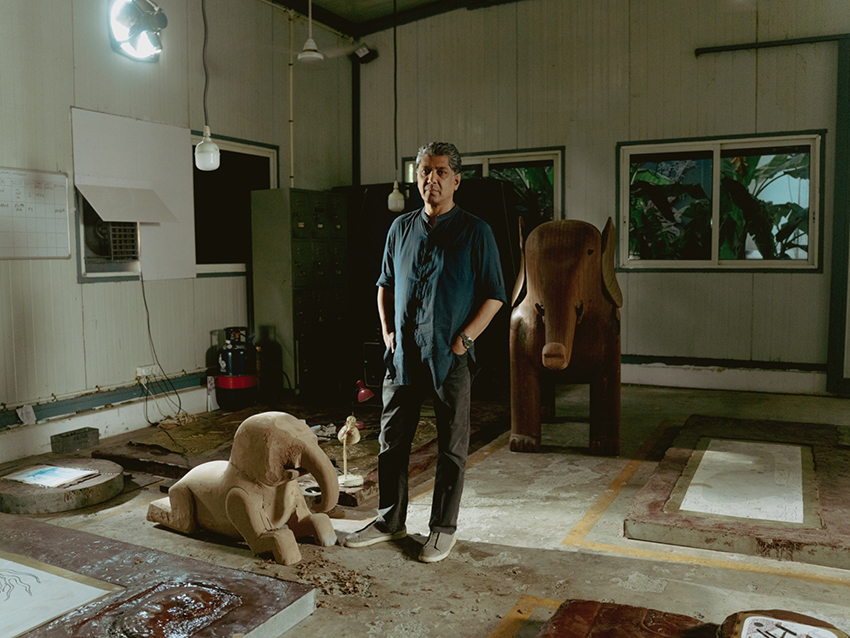
From brass workshops to global design galleries, Vikram Goyal is making the case that Indian craft is not a relic of the past — it is the future of design.
Vikram Goyal's path to design was never conventional. Trained as an engineer, he spent years in finance across continents before returning to India in 2000 — and to something far harder to name than a career pivot. It was, more precisely, a homecoming to a visual and material world he had always carried with him. "Design evolved out of a curiosity for objects, materials, and how things are made," he reflects.
Over the past twenty-five years, that curiosity has shaped a practice that has helped redefine the global perception of Indian design. Through Vikram Goyal Studio, his collectible works have found a place in leading international galleries, including Nilufar, The Future Perfect, and PAD London. Meanwhile, his lifestyle brand Viya extends his design language into objects for everyday living.
In conversation with Vikram Goyal, we speak about his journey and why materiality remains at the heart of everything he creates.
Excerpts from the conversation:
1. Where were you raised as a child and what other parts of the world have you lived in? And have those cities in any way influenced your designs and design thinking?
I was raised between Rajasthan and Delhi, in environments where art and craft were part of everyday life rather than something confined to galleries. In Rajasthan especially, beauty is woven into daily existence, whether in the carving of a door, the rhythm of a jaali, or the patina of an old metal pot. Our home had brass lamps, engraved utensils, miniature paintings, and embroidered textiles that carried stories of time and touch.
Over the years, I’ve spent time in cities like New York and London, which exposed me to a very different design vocabulary, one that is often more restrained, conceptual, and system-driven. That contrast has stayed with me. My work sits somewhere between these worlds: deeply rooted in Indian materiality and narrative, yet informed by a global sensibility that values clarity, precision, and context.
2. Who or what was your inspiration for pursuing design?
I did not begin with formal training in design; instead, it evolved out of a curiosity for objects, materials, and how things are made. Most important has been learning from craftsmen and artisans, understanding processes hands-on, spending time in workshops, and engaging deeply with technique. That exchange has been my real education.
3. You work extensively with brassware. What keeps that material interesting after so many years?
Brass, for me, is not a static material; it is incredibly responsive and holds memory. Whether cast, textured, or patinated, each process leaves a trace of the hand, so it’s constantly evolving in its expression. Working with brass, you cannot rush the process; you have to listen to the material, understand its rhythm, and let it reveal its character over time. That slower, intuitive engagement is central to my practice.
I am drawn to its duality; it carries a sense of antiquity, yet can feel entirely contemporary depending on how it is treated. What sustains my interest is the depth it offers, each piece becomes an opportunity to explore new forms, finishes, and ways of working with craftsmanship.
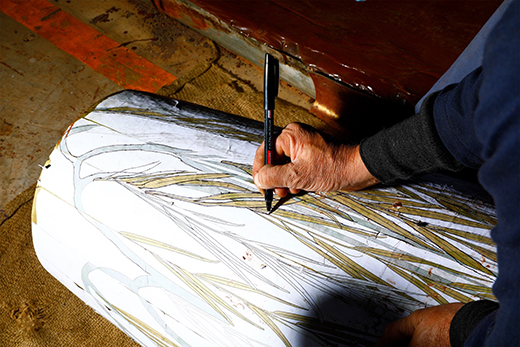
(Image Credits: Vikram Goyal Studio)
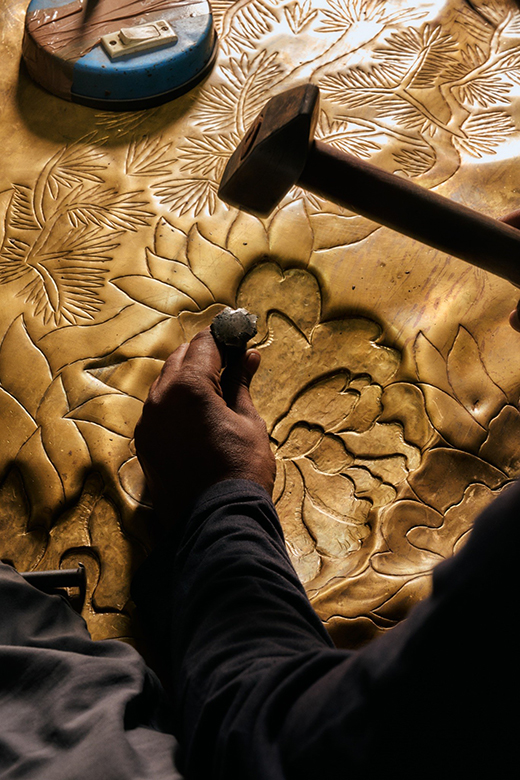
(Image Credits: Vikram Goyal Studio)
4. Many of your pieces use techniques like repoussé and pietra dura. How do you balance preserving these crafts with pushing them forward?
For me, preservation is not about freezing a craft in time; it is about giving it relevance. Techniques like repoussé or pietra dura have extraordinary histories, but they need new contexts to survive. We approach them not as static traditions but as living languages. By applying them to contemporary forms and ideas, we allow the craft to evolve without losing its integrity.
5. A lot of your work draws from Indian history and philosophy. What specifically do you look for when you study them and what inclines you towards them?
I am drawn to the layered nature of Indian thought, its symbolism and multiplicity of meanings. When I engage with history or philosophy, I am not looking to replicate it literally. I am more interested in distilling an essence, an idea, a rhythm, and a way of seeing. It could be something as abstract as impermanence or as visual as a motif from temple architecture. These become points of departure rather than direct references, shaping the work in a way that feels both rooted and contemporary.
6. Can you explain your studio’s structure?
The studio functions as a collaborative ecosystem. At its core, it’s a dialogue between designers, artisans, and technical experts. We have in-house teams that work on design development, prototyping, and production, alongside a network of master craftsmen across India. The process is iterative and ideas evolve through making. It’s less hierarchical and more about a shared pursuit of excellence.
7. Take us through Viya? What was the idea behind it, and what kind of space were you trying to create?
Viya was conceived as a more immersive and accessible extension of the studio’s philosophy. While the studio often works on highly bespoke, collectible pieces, Viya allows that language to translate into a more lived-in, everyday context.
The idea was to create a space that feels holistic, where objects, interiors, and apparel come together to form a cohesive environment rather than existing in isolation. This thinking comes through in Viya’s Mumbai flagship at Trafford House, where the architecture, objects, and spatial experience are all in dialogue, unfolding almost like a lived environment rather than a conventional store. At its core, Viya is about how design integrates into daily life. It explores a quieter, more continuous relationship with craft, where pieces are not just statements but companions to living, creating a space that feels tactile, immersive, and deeply considered.
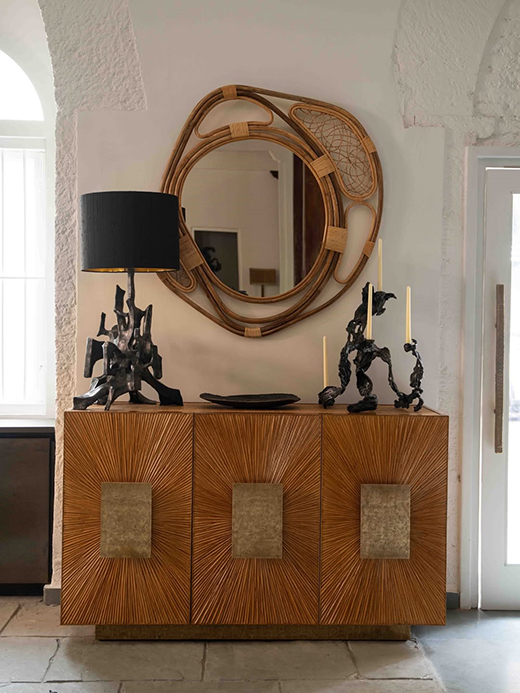
(Image Credits: Viya Store)
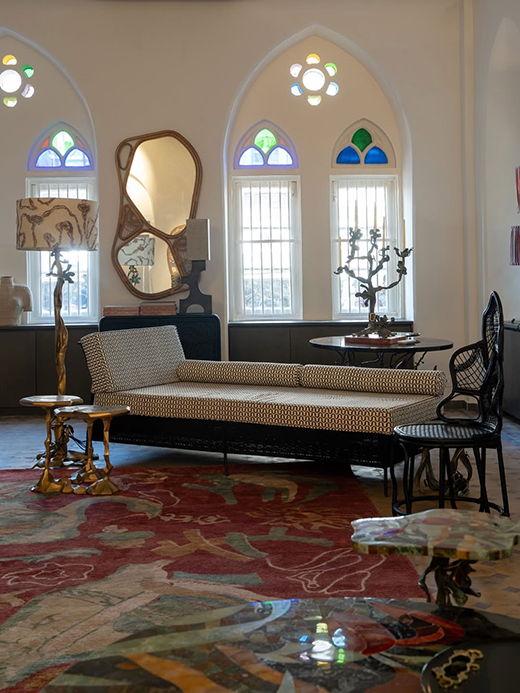
(Image Credits: Viya Store)
8. You’ve been involved in causes like wildlife conservation and craft economies. Do you think design has the power to raise awareness for these causes?
Absolutely. Design has the ability to communicate without being prescriptive. It can create emotional connections—whether it’s through a material, a narrative, or an experience. When people engage with an object that carries a story—be it about a craft tradition or an ecological concern—it fosters a deeper awareness. It’s a subtle but powerful form of advocacy
9. What do you think Indian design still gets misunderstood globally?
There’s often a tendency to see Indian design through a lens of ornamentation or maximalism. While that is certainly one aspect, it overlooks the depth of thought, the sophistication of craft, and the conceptual rigour that exists within Indian practices. Indian design is not just decorative; it is deeply intellectual and rooted in systems of knowledge that go back centuries.
10. Where do you see your work evolving in the next 5–10 years?
I see it becoming more expansive, across disciplines, geographies, and scales. There’s a growing interest in creating environments rather than just objects, and that’s something I’m keen to explore further. Increasingly, global exposure through exhibitions, collaborations, and new markets, is also shaping the way the work evolves, allowing it to be in dialogue with a wider audience and different cultural contexts. At the same time, I want to continue deepening our engagement with craft by finding new ways to innovate within traditional frameworks while retaining their integrity and relevance.
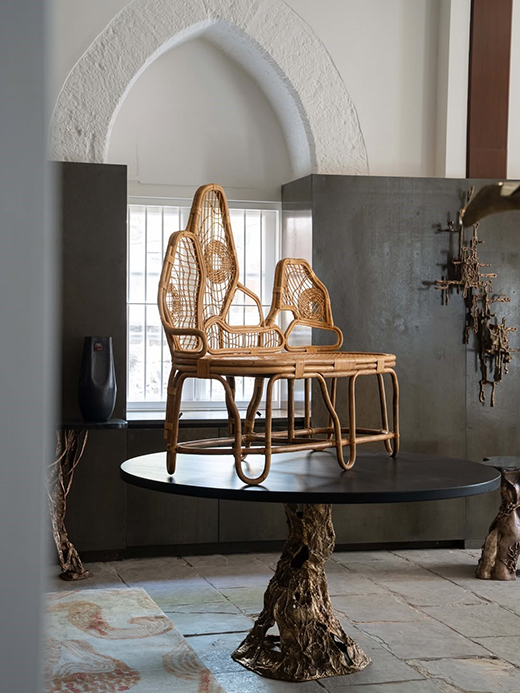
(Image Credits: Viya Store)
11. Do you have a favourite piece?
I’m especially drawn to the pieces from our cane collection. A few of them explore a combination of cane and metal, and those, in particular, feel very personal to me. I’ve had a long-standing fascination with cane; it’s a material I’ve been surrounded by since childhood, and over time I’ve come to appreciate the incredible craftsmanship it demands.
12. What’s next for you?
What’s next is really about building on what we have started – expanding Viya and exploring new geographies and continuing to push the boundaries of material and craft. There are also new collaborations and exhibitions on the horizon, which allow us to present the work in different contexts. It’s an ongoing process of evolution.
Cover Image Credits: Ali Monis Naqvi